The engineering, biological science and nanotechnology degrees would help students interested in higher-level science fields better prepare for graduate school.
And, the degrees could initiate new partnerships with the Virginia Bioinformatics Institute at Tech. There, laboratory scientists work cooperatively with high-level computer programmers and other scientists to produce new cancer treatments, among many other sponsored research projects.
Developed in consultation with alumni who work in real estate, that degree proposal would incorporate studies in engineering, agriculture and business, among other elements. If it is ultimately offered, the degree is expected to allow students to take advantage of a housing market rebound, Wubah said.
It is also thought that graduates of the program would be well-positioned in the field because officials found that about "25 percent of Northern Virginia real estate is controlled by Hokies," Wubah said.
All the new proposed degrees would emphasize interdisciplinary studies and undergraduate research -- two major areas of focus at Tech.
In fact, research and interdisciplinary elements will be required for any new undergraduate programs, Wubah said.
"Siloed programs ... are not the future," he said. "The major problems we face ... can't be solved in one discipline. If you take energy, water. Solving those problems takes understanding beyond one discipline."
Requiring biology students, for example, to also take a course in physics and another in chemistry produces graduates who are aware of how other scientific disciplines affect their own field.
"They will have an area they will focus on. But we want them to think laterally," Wubah said.
Wubah came to Tech in 2009 from the University of Florida, where he served as associate provost for undergraduate academic affairs. Since his arrival, he has adopted a review system for new degree proposals similar to one used by graduate school Dean Karen DePauw.
Under this system, concept plans for new degrees are reviewed first by the dean, and then by a committee system within the university. Market research and a detailed explanation of how the degree will prepare students for academia or the work force are required.
If approved by the University Council and the board of visitors, the plan then goes to the State Council of Higher Education for Virginia, and in some cases the Southern Association of Colleges and Schools, for final approval.
From start to finish, implementation of new degrees normally takes about three years, Wubah said.
Both the undergraduate and graduate offices keep and monitor a prioritized list of new program proposals that is reviewed on an annual basis.
Since 2004, the graduate school has used the same process to add 11 new doctoral and master's degrees, as well as certificates and dual degree programs, DePauw said.
Since coming to Tech in 2002 from Washington State University, DePauw has nurtured a resurgence of graduate education at Tech. That resurgence has been instrumental in boosting Tech's overall goal of increasing funded research contracts, as well as helped foster the university's diversity and equity goals.
DePauw echoed Wubah's comments on the importance of an interdisciplinary approach to new degree development, saying she has watched the trend grow in importance over the past 20 years.
Research and science have not been the only areas of focus for the grad school, however. DePauw pointed to the creation of a doctorate in rhetoric and writing and Master of Arts in foreign languages, cultures and literature, and creative technologies.
Research and STEM (science, technology, engineering and mathematics) remain the primary focus of Tech's growth, however.
Increasing research funding has been a signature goal of President Charles Steger's administration, and it has become more important as the university looks to high-tech companies, federal agencies and others for grant money to help offset declining state funding.
Officials say that outside money helps fund salaries, erect buildings and buy laboratory equipment, among other benefits.
By: Tonia Moxley
Roanoke Times
Tuesday, April 12, 2011
Virginia Tech Proposes 5 New Degrees


Wednesday, April 06, 2011
2011 Virginia State Science Fair Awards for Biotechnology
The Virginia Biotechnology Association (VABIO) in conjunction with the Chesapeake Bioscience Education Foundation presented awards at the 2011 Virginia State Science and Engineering Fair on Saturday, April 2, 2011, at Old Dominion University in Norfolk. The volunteer judges studied the abstracts prior to their arrival at the Fair and then voted on the top ten projects to interview one-on-one. Photos from the competition are available here.
"Once again, the students' projects amazed the judges. It was hard to choose among so many excellent projects," said Mark Herzog, VABIO executive director.
After talking with each of the students, the judges made their final selections:
First Place: Charlotte Nina Keeley and Emily Jane Keeley
“Creating a SmartBandage: A Nanoparticle-Embedded Polymer to Detect Local Oxygen Levels in Wounds” (ENT007)
Category: Engineering: Materials and Bioengineering
Region: Charlottesville
Second Place: Choonh-Seoup Youn
“Regulation of Telomerase Activity in Prostate Cancer Cell by a Novel Protein, DEK” (CMI003)
Category: Cellular – Molecular Biology
Region: Fairfax
Third Place: Benjamin Tyler Cobb and John Conor Moran
“Identification of Novel Stress – (Cortisol) Dependent Cisplatin Resistance in Lung and Breast Cancer Cells” (CMT002)
Category: Cellular - Molecular Biology
Region: Fairfax
Thank you to our VaBIO Judges:
David Anderson, Vice President Scientific Affairs, Lyotropic Therapeutics, Inc.
Martin Chapman, President, Indoor Biotechnologies, Inc.
Michael Francis, Research Associate, LifeNet Health
Mark Herzog, Executive Director, Virginia Biotechnology Association
Eugene Maurakis, Director of Science Education, Science Museum of Virginia
Roy Ogle, Director of Regenerative Medicine, LifeNet Health
Gary Pekoe, Founder, Arkios Biodevelopment International
Patrick Sachs, Research Associate, LifeNet Health
Tuesday, March 29, 2011
Local News Video: New Biotech Labs for Charlottesville
The historic former home of Coca-Cola in Charlottesville is getting a new high-tech future. Monday morning, the city announced a major development will fill the space on Preston Avenue with labs and research companies. This project is a first for the city.
Citycampus Biotechnology Center will begin transforming the 72-year-old former soda bottling plant into state-of-the-art labs. The city and Virginia Biotechnology Association presented the plans Monday morning.
Citycampus Center will be the first fully-equipped wet lab space in Charlottesville - labs where researchers can test chemicals, drugs, and biological materials. Indoor Biotechnologies Incorporated is buying the building from Coke and will be the lead tenant in Citycampus.
The United Kingdom based company sells allergy and asthma products and services around the world.
Indoor Biotechnologies President Martin Chapman said, "If we provide space for expansion, we can clearly develop more of that industry and hopefully recruit biotech companies to come from other parts of the state, which would be terrific."
The project to rehabilitate the 1939-era Coca Cola building will cost Indoor Biotechnologies $3-$5 million and will take about two years to finish. At full-build out, the facility will create 110-150 high-tech, high-paying jobs.
The city expects the project will keep UVA research spin-off companies in Charlottesville.
Click here for the video link: http://www.nbc29.com/category/175568/video-landing-page?clipId=5701013&autostart=true
Tuesday, March 22, 2011
Insmed Regains NASDAQ Compliance
Insmed Incorporated (Nasdaq CM: INSMD), a biopharmaceutical company, today announced that it has received notification from The NASDAQ Stock Market that it has regained compliance with the minimum $1.00 per share bid price requirement.
To regain compliance with the bid price rule, Insmed was required to maintain a minimum closing bid price of $1.00 per share or more for a period of at least 10 consecutive business days. On March 16, 2011, the closing price of Insmed's common stock was $5.02 per share, the tenth consecutive business day the stock price had closed above $1.00 per share. The NASDAQ Capital Market has indicated that this matter in now closed.
Insmed will continue to trade on The NASDAQ Capital Market.
March 21, 2011
citybizlist
ADial Pharmaceuticals, Led by UVA Profs, Raises $4.1M
According to an SEC filing, ADial Pharmaceuticals, L.L.C., developer of medications to treat addictions, completed a $4.1 million offering.
The company was founded by Prof. Bankole Johnson, who serves as president and chairman.
Dr. Johnson is Alumni Professor and Chairman of the Department of Psychiatry and Neurobehavioral Sciences at the University of Virginia. He is well-known for his discovery of compounds that have been effective in the treatment of alcoholism. Professor Johnson also received national media attention for his appearance in the Home Box Office (HBO) original documentary feature, "Addiction", which won the prestigious Governors Award, a special Emmy Award, from the Academy of Television Arts and Sciences.
Dr. Johnson is named in the filing, along with CEO William B. Stilley and CFO John F. Riccardi; and directors Robert S Capon, Mike L. King, Ming D Li, and Wendy L Yarno.
Capon, King and Li are all members of the University of Virginia faculty. Capon was also the co-founder and former CEO of Charlottesville-based Adenosine Therapeutics.
March 16, 2011
citybizlist
Monday, March 21, 2011
Virginia To Start Using Familial DNA Searches for Criminals
Governor Bob McDonnell announced today that the Virginia Department of Forensic Science (DFS) has developed the capability to perform a technique known as familial DNA searching. This application will expand DFS’ ability to assist in criminal investigations by searching its DNA database for a person or persons who may be closely related to an unknown individual, not in the database, whose DNA has been identified on an item of crime scene evidence and consequently is being sought as a suspect in a specific crime.
“It is vital that our law enforcement agencies have every available tool at their disposal to protect public safety and investigate the most violent crimes in the Commonwealth,” said Governor McDonnell. “This new technology will allow forensic experts to develop leads otherwise unavailable to law enforcement officers that can expedite the identification of criminals in certain cases and can get these offenders off the streets before any further loss of life or injuries to citizens occur.”
Familial DNA searching is currently being used in California and Colorado to provide law enforcement investigators leads to possible criminal suspects, and was instrumental in the 2010 capture of a murder suspect in California’s “Grim Sleeper” cases. The computer software required to perform a familial search of profiles in Virginia’s databank of convicted offender and arrestee DNA samples was developed by and provided to DFS without cost by the Office of Denver District Attorney Mitch Morrissey. The acquisition of the Denver software and the DFS laboratory personnel’s review to validate its suitability for searching Virginia DNA databank profiles followed requests from several local prosecutors to consider applying the technology to a number of unsolved crimes that occurred in the Commonwealth.
Virginia law requires that persons convicted of or arrested for certain specified crimes provide a sample of their DNA for inclusion in the state databank of DNA profiles. In a typical search of the database, a match is determined if a DNA profile in the databank is essentially the same as a DNA profile found on crime scene evidence. If a typical search does not result in a match, it is possible that a familial search could identify one or more database profiles that bear a strong similarity to the crime scene profile, suggesting that the persons who provided the DNA may be related. Further DNA analysis can be conducted to determine the likelihood of a family relationship before the names of potential relatives are provided to law enforcement officials for investigation. The success of identifying a lead to the perpetrator of an unsolved crime depends upon a parent, child, or sibling of the perpetrator having previously provided a DNA sample by law as a convicted offender or arrestee.
“I am grateful for the assistance the Commonwealth has received from Denver District Attorney Mitch Morrissey and his staff, and I am enormously proud of the effort undertaken by the Virginia Department of Forensic Science to put this technology in place,” said Governor McDonnell. “As always, DFS has proceeded with the care and deliberation required to ensure confidence in its results and the highest level of service to the law enforcement agencies of the Commonwealth. Familial DNA searching, which must be used cautiously and sparingly, provides another important tool to assist law enforcement in some of their most difficult and heinous cases where the safety of the public remains a concern.”
DFS has issued a policy for considering requests from law enforcement officials to conduct familial DNA searches in cases involving unsolved violent crimes against persons where other investigative leads have been exhausted and critical public safety concerns exist. In such a case, if crime scene evidence has yielded a DNA profile suitable for searching and law enforcement officials and prosecutors commit to further investigation if a potential relative is identified, the DFS director will direct that a familial DNA search be performed in accordance with departmental scientific protocols.
Wednesday, March 16, 2011
Commonwealth Biotechnologies removes board chairman
Commonwealth Biotechnologies Inc. said it has removed its board chairman after he urged shareholders to support his own reorganization plan for the company, which is operating under Chapter 11 bankruptcy protection.
The Chesterfield County-based research and development company said in a statement Tuesday that its board voted March 11 to remove William Guo as chairman and as a director of the company.
Guo, an entrepreneur in China who founded the pharmaceutical company VenturePharm Group, filed various submissions with the Securities and Exchange Commission on March 9, March 11 and again on March 14.
In the filings, Guo urged shareholders to support a reorganization plan that would make him the sole director of the company at a salary of $1. His letter to shareholders claimed that the company's co-founder and chief executive officer, Richard Freer, was unqualified to serve as CEO. He called for a shareholders' meeting in late March.
The company said in a statement Tuesday that Guo's filings were "unauthorized" and were "replete with factual errors, misleading comments and baseless allegations."
The company said its board of directors demanded that Guo retract the statements and inform the Securities and Exchange Commission that the filings were unauthorized. He declined to do so, according to the statement by the company.
Guo also called for the company to delay the sale of its 32,000-square-foot building at 601 Biotech Drive in Chesterfield. Instead, Guo said he wants to cut the company's administrative expenses and pay off its unsecured debt partially with common stock and partially with cash from the sale of its only remaining operating unit, Mimotopes Pty Ltd., a drug discovery and research business in Australia.
A phone message left Tuesday at Commonwealth Biotechnologies seeking comment was not returned. A U.S. representative for Guo listed in the SEC filings said Guo was not available for comment Tuesday.
Commonwealth Biotechnologies provides research services to the biotech industry. Founded nearly 20 years ago by four Virginia Commonwealth University scientists, it was the first business to occupy space in the Virginia Biotechnology Research Park in Richmond in 1994.
In 1999, two years after it sold stock publicly, it moved to a new headquarters and laboratory building in Chesterfield.
After reporting millions of dollars in annual net losses since 2006, the company announced plans last year to sell its assets, pay off its debts and seek a merger partner.
It filed for Chapter 11 bankruptcy protection in January to protect itself from creditors and to halt a foreclosure auction of its building.
The company's plan is to sell its assets and make itself a shell company. It would then seek to complete a "reverse merger" by finding a privately owned company seeking to become public by acquiring a shell business with stock that is already publicly traded.
By: John Reid Blackwell
March 16, 2011
Richmond Times-Dispatch
Tuesday, March 08, 2011
Daily Progress: VA Needs to Focus on Biotech
In the University of Virginia, our Charlottesville region possesses one of the nation’s top teaching hospitals and one of the nation’s top business schools. For these reasons and more, our area already is doing well in biotech entrepreneurship.
But it could be positioned for even greater growth.
And the commonwealth as a whole would be smart to better support this important and growing industry, for the sake of economic and humanitarian advancement.
Biotech is a special industry, says Mark Herzog, executive director of the Virginia Biotechnology Association — both in its promise and in its needs.
Some of the most exciting innovations in science are occurring in this field, including in such areas as potential cures for cancers and bioremediation of pollution. When this research comes to fruition, the gains for humanity will be enormous.
Already, quality and longevity of life are being immensely improved by biotech advances.
Although biotech scientists generally pursue their research for love rather than riches, the economic benefits from biotech also can be substantial. And it is economic benefit to the community, more than to the individual, that brings the biggest payoff.
Biotech firms need highly trained workers, who can be highly paid for their special skills, and that money helps feed the local economy.
Biotech firms need support businesses — from accountants, to attorneys (working through red tape can take years) to advertising experts (to market successful products). Spinoff and support firms also contribute to the economy.
†Biotech firms also have special needs. In addition to specially trained workers, they also need specialized facilities, particularly wet labs. It is far more expensive to build these facilities than to construct typical office or manufacturing space.
Higher startup costs unfortunately often combine with delayed return on investment. It can take 20 years to bring a new drug to market — 20 years of meticulous research, testing and adhering to government regulations.
The rewards from biotech research can be huge — equally, the risks. Although some “angels” are attracted expressly to the excitement of bioscience, many venture capitalists don’t understand the unusual realities of the industry, or are unwilling to accept its uncertainties.
That means funding for promising new fields of research can be hard to come by.
It’s also why the statistic cited in the March 6 editorial is so important. Virginia is not just 50th, but 52nd — behind even Puerto Rico and the District of Columbia — in categories tracking changes in the amount of grant money our companies are able to attract from the National Institutes of Health. Even when public money is available, Virginia is doing a relatively poor job of pulling it in.
That’s just one measure of success, but it tells a vital part of the story.
Other states are forging ahead in biotech research — in fact, they are so far ahead that our own young scientists are leaving to pursue careers elsewhere.
With its nationally ranked universities, its ties to the defense industry and its proximity to Washington, Virginia could be — should be — a leader in bioscience. But Virginia must determine to capitalize on those resources and determine to add to them.
The risks of inaction are high; the rewards of success, virtually unlimited.
Editorial By The Daily Progress, Published: March 08, 2011
http://www2.dailyprogress.com/news/2011/mar/08/va-needs-focus-biotech-ar-891518/
Monday, March 07, 2011
Va Should Position For Growth
The greater Charlottesville region is home to more than 17 percent of the state’s biotech companies, based on information from the Virginia Bioscience Directory.
It contains more than 20 percent of the state’s bioscience equipment companies, nearly 18 percent of its medical device companies and nearly 17 percent of its bioenergy companies.
That’s a pretty good record — and it doesn’t even include firms in nearby Waynesboro and Staunton.
And it all adds to the local economy.
With much of this innovation sparked by the University of Virginia, the region is doing well in comparison with other parts of the state. But more could be accomplished.
And significantly more could be accomplished statewide if the commonwealth’s leadership would bring state policies up to speed in this emerging tech field.
That’s the view of Virginia Biotechnology Association Executive Director Mark A. Herzog. He was in Charlottesville last week for a biotech conference and took time out to speak with The Daily Progress editorial board. And he made a strong case for increased public support of biotechnology startups and homegrown companies.
First, a snapshot of where Virginia stands today in comparison with other states:
“When’s the last time you saw Virginia at the bottom of anybody’s list?” Mr. Herzog asked.
Well, there we are: Not just 50th, but 52nd — behind even Puerto Rico and the District of Columbia — in categories tracking changes in the amount of grant money our companies are able to attract from the National Institutes of Health. The figures from a Batelle study show that Virginia actually lost ground in those categories from 2004 to 2009.
It’s just one small part of the overall picture — but it’s a dramatic one, and deserves attention.
Here’s another startling statement: “We’ve become an incubator for other states’ bio industries,” says Mr. Herzog.
Too often, our people — UVa post-docs, for instance — cannot remain in the commonwealth because the jobs aren’t here, and the jobs often aren’t here because the venture capital for exciting new startup companies comes from out of state.
In other words, Virginia might be producing brilliant researchers who have world-class ideas for new medical drugs or new biofuels, but we are not always providing an environment that allows them to develop their ideas and take them to market. We are not completing the loop. And when they must export their ideas elsewhere, Virginia experiences the ill effects of brain drain and lost economic opportunities.
Clearly, the Charlottesville region isn’t doing too badly, with its relatively high percentage of biotech companies. But imagine how much more powerful that economic engine could be if the state provided the right tools for growing it.
Some of the world’s most exciting — and humanitarian — innovations are occurring in this field. And Virginia should position itself to be an integral part of these advances.
Wednesday, February 23, 2011
VA Assembly Honors Henrietta Lacks
From the Virginia Pilot:
Va. legislators honor woman whose cancer became a cure
After six decades of obscurity, Henrietta Lacks was honored Tuesday by the Virginia General Assembly for the revolutionary advances in medicine made possible by her harvested cancer cells.
Watching from the gallery were surviving family members, many of whom lack health insurance as biomedical companies make millions from her legacy.
A doctor from the medical school where the saga began acknowledged that the case raises difficult issues of medical ethics.
Lacks was born in 1920 and raised by her grandfather on a tobacco farm in Clover, a crossroads in Halifax County where her ancestors had toiled as slaves. She married in 1941 and moved to Baltimore.
In 1951, she died of cervical cancer at Johns Hopkins Hospital, where doctors – following the common practice of the day – had taken samples of her tumor without asking permission of Lacks or her family.
The cells, it turned out, had an incredible ability to divide and replenish themselves indefinitely, creating a line that has been used worldwide in medical research. HeLa cells, as they are known – an abbreviation of Lacks’ first and last names – contributed to the invention of the first effective polio vaccine by Jonas Salk and treatments for cancer and AIDS.
Lacks’ family didn’t learn the full story of her monumental contribution to medicine until publication last year of the widely praised book “The Immortal Life of Henrietta Lacks” by Rebecca Skloot.
They listened Tuesday as Del. Jeion Ward, D-Hampton, sponsor of a resolution commemorating Lacks in observance of Black History Month, called her story “a source of pride and celebration not just for African Americans but for all mankind.”
Among those at the presentation and a news conference was Lacks’ son David Lacks, 63, a part-time truck driver in Baltimore with no health insurance.
He and other family members have struggled to make sense of a system in which corporate medicine benefited handsomely from their ancestor’s legacy while they scraped by.
“It would be nice if we could get some compensation,” he said.
Dr. Daniel Ford, vice dean for clinical investigation at Johns Hopkins, said “it has taken too long for Johns Hopkins to recognize the contribution of Henrietta Lacks.”
But any financial payment to the family by the hospital would be a “bad precedent,” Ford said, noting that Johns Hopkins gave the cells away to other researchers. It now pays $100,000 a year to companies that produce HeLa cells for research at Hopkins.
The compensation issue is “a very complicated question,” he said. “As a society we’re all still trying to work that out.”
http://hamptonroads.com/print/590040
Is Randal J. Kirk Biotech's Best Investor?
"This morning, Forest Laboratories announced plans to buy anti-depressant maker Clinical Data for $30 per share, plus a $6 dollar payout contingent on sales of the company’s drug, Viibryd. I wanted to get this story — a portrait of Clinical Data’s main backer, billionaire investor R.J. Kirk — out as quickly as possible.
The print story, which I wrote with Robert Langreth, will appear in the next issue of Forbes magazine. The deal pays out less than Clinical Data’s $33.90 closing price on Friday, but still locks in plenty of gains for Kirk, who has been backing the company for years. The full magazine story appears below." - Matthew Herper
Grand Plans
Investor Randal J. Kirk became very rich making small improvements to old drug classes. Now he and partner Thomas Reed want to change the world.
Biotechnology produces few billionaires. The high costs of drug development mean that most early investors no longer own big stakes by the time a medicine finally gets to market. Randal J. Kirk, a Virginia biotech investor whose net worth FORBES estimates at $2.2 billion, upends this rule. Instead of spreading his bets and taking profits early like most venture capitalists, Kirk bets big on a few small companies and stays the course until a product gets to market. He reaped $1.2 billion in 2007 when he sold his New River Pharmaceuticals and its attention deficit disorder drug to Shire for $2.6 billion. His next big score could come from his biotech company Clinical Data, whose antidepressant Viibryd was approved in January. Its shares have doubled this year on speculation that Kirk will soon sell to a big drug company desperate for new products. Kirk, with common stock, convertible notes and warrants, is sitting on a 52% stake worth over $600 million. [Note: Clinical Data today announced plans to sell to Forest.]
But Kirk says everything he has done in the past pales next to the potential of his latest project: Intrexon, a secretive research-stage company that is working on the hot new field of synthetic biology—basically genetic engineering on steroids. Kirk and his investment fund, Third Security, have poured $200 million into the closely held 180-person company based in Blacksburg, Va., which has no drugs on the market.
“I’ve been a biotech investor for 27 years, and Intrexon is by far the best thing I’ve ever seen,” says Kirk, 56, who raises falcons and composes electronic music on a 7,200-acre cattle farm in rural Pulaski County, Va. He likens Intrexon to “the Google of the life sciences” and predicts that in a decade it could become “the largest, most significant company” in its burgeoning field.
Today’s biotech industry makes modest genetic tweaks to living cells—adding or deleting single genes so bacteria will produce insulin or corn will resist pests, for example. Synthetic biology aims to make much more radical changes and reengineer living cells from the ground up. One goal is to make protein drugs far more cheaply and efficiently than is possible today. Another is to transform living cells into tiny molecular factories to make everything from gasoline to construction materials. Some scientists even want to create entire new life forms from scratch.
Lots of big scientific names are working in synthetic biology, which so far has produced lots of hype and headlines but few practical breakthroughs. Gene jockey J. Craig Venter, known for sequencing the first human genome in 2000, leads a company called Synthetic Genomics that has a $300 million deal with ExxonMobil to make designer biofuels.
Intrexon has released few details about which products it is pursuing. Its lead drug is only at the earliest stage of human trials. It is so obscure that three prominent synthetic biology researchers contacted by FORBES—including Venter—said they had never heard of it. Kirk shrugs. Among other colossal ambitions, he wants to revitalize the troubled field of gene therapy, make dozens of inexpensive protein drugs and produce better genetically engineered crops that will benefit consumers, not just farmers. The company is also working on biofuels, designer enzymes, bioplastics and unspecified consumer products. Keeping the work secret is part of the plan, Kirk says. “If we were in the business of publishing, we could get the cover of Science magazine any issue we wanted,” he boasts.
The scientist behind Kirk’s mystery company is the 45-year-old molecular geneticist Thomas Reed. He founded Intrexon in 1998 while still completing his Ph.D. and postdoctoral work in cardiovascular genetics at the University of Cincinnati. “I think of him as the Henry Ford of DNA,” says Kirk. “We are all living in his dream.”
By Robert Langreth and Matthew Herper
Forbes Online
Wednesday, February 16, 2011
Genzyme CEO on How Biotech Grew in Boston
Henri Termeer quote on how biotech grew in Boston:
"Genzyme and other Boston biotech companies, like Biogen and Genetics Institute, grew here, Termeer told me, because of the presence of top-notch universities and venture capitalists with money to invest. One thing that wasn't here: big pharma companies. Their absence allowed Genzyme and others to hire the best scientists and product development people, and point them at audacious goals. "It was a magnificently pioneering time," Termeer said. The biggest pharmaceutical companies were focused on making "enormous money with small, incremental improvements on their products," and then hawking those improvements with their "enormous marketing power." That created a vacuum in which Genzyme and a handful of other big biotechs grew."(from the Boston Globe)
Monday, February 14, 2011
Chesterfield Business Tests Building Systems
Bill Wassum's hunch about adding a niche service to C&W Tesco Inc.'s operations in 2003 has paid off.
"I saw it on the horizon," he said about providing the service, called building-systems commissioning, that ensures building systems such as lighting, plumbing and heating, ventilation and air conditioning operate together as intended.
"No one was doing it in this area. I thought we should go after it."
Adding the niche service has meant hiring more workers and increasing sales at the Chesterfield County-based business.
Twenty employees — eight in the past three years — have been hired since 2003. "And we are keeping them busy," Wassum said.
The company, which also provides testing and balancing of building systems, grew 300 percent in sales between 2003 and 2009.
Much of that growth came from adding building-systems commissioning services. But part of the increased revenue is a result of the company's in-house training program, Wassum said.
"We have positioned ourselves trainingwise and philosophywise to take advantage of the market. We have worked hard on seeing problem jobs to the finish."
Bob Randall, energy manager for Stafford County Public Schools who also did testing and balancing of HVAC systems for 20 years, describes C&W Tesco as "an old-school company."
"They do very good quality work, and they are very easy to get along with," he said.
Bob Fagel, senior project general manager for Centennial Contractors Enterprises Inc. in Reston, looks to C&W Tesco to resolve issues he might have regarding building systems. Centennial is working on a contract at Fort Lee.
"They are very professional in everything they do with us," Fagel said. "We look at them as part of our team when it comes to working on mechanical projects with the government. They are very much responsible for some of the success we have had here at Fort Lee."
Providing employee training is key for C&W Tesco, Wassum said.
"We have a class for employees every two weeks. We teach from the technician's training manual," he said. "We have managed to certify all but six employees."
Certification will become even more important in the years ahead. The National Environmental Balancing Bureau and the Associated Air Balancing Council will require that every job have at least one certified technician on site beginning in 2012, Wassum said.
"We have been doing that since 2003," he said.
Ray Burroughs, estimator for Atlantic Constructors in Chesterfield, uses C&W Tesco for tough projects. "They are reliable, and their estimating is always on time," he said. "They provide quality proposals."
C&W Tesco's clients include federal, state and local governments as well as retail, commercial and industrial companies. The firm does 90 percent of its work in Virginia but has taken jobs across the country and also in Warsaw, Poland.
"We are certified worldwide," Wassum said.
He thinks biotechnology will become a growing market for C&W Tesco, which recently became involved with the Virginia Biotechnology Association.
The biotechnology corridor from Tidewater through Charlottesville is a big market for testing, he said.
Two of the company's employees recently completed classes offered by the National Science Foundation in a type of biotechnology testing. They also have taken classes in the testing of fume hoods, which can detect toxic gases.
"We are currently getting our certification in that," Wassum said.
The company is exploring the market demand for its biotechnology services overseas.
"We will go anywhere that we are qualified to do the work," Wassum said.
Wassum started the company in 1983 with Carol Comstock as C&W Air Balancing, providing testing and balancing of HVAC systems. Comstock left C&W in 1984.
Tom Howard became an owner in 1995 after C&W merged with his Virginia Test & Balance company. John Papazian did the same in 2004 when his company, Tesco, merged with C&W, and the company changed its name to C&W Tesco.
By Joan Tupponce
Richmond Times-Dispatch
WVA Steps Up Recruiting Efforts
Maryland and Virginia are always competing with each other for big-name technology companies to locate to their states.
Now, West Virginia may be jumping into the fray.
A West Virginia economic development organization has hired CSC, a Falls Church, Va.-based IT solutions and services firm, to bring more biometrics companies to the state. And the organization recently devised a plan to increase its bioscience industry.
CSC, which usually gets hired to provide tech solutions and services to commercial and government customers, will spend the next 18 months developing a biometrics and identity program for TechConnectWV, a not-for-profit group that’s trying to bring more technology companies to West Virginia.
The program, which is being run by CSC’s Identity Labs in Fairmont, W. Va., is expected to advance the state’s identity management industry and spur job growth, intellectual property development and sustainable business.
Much of the work will be done with the newly formed Biometrics Innovation Institute Program, which is also working to accelerate the biometrics industry in West Virginia. As part of this contract, CSC will help put together a grants program to help give the industry a jumpstart.
TechConnectWV will also work on growing the bioscience industry in West Virginia. The organization’s plan is to continue growing academic-based research, advance biotech clusters by strengthening bonds between research universities and industry, improve the biotech workforce and enhance the infrastructure to help entrepreneurs grow their businesses.
Washington-area economic development leaders aren't too worried just yet.
Virginia officials, in fact, say they welcome the competition from its westward neighbor. The Virginia Biotechnology Organization even helped launch the Bioscience Association of West Virginia in 2009.
"A growing and vibrant life science industry in the Mountaineer State is beneficial to her neighbors as it means more companies, more research dollars and a wider pool of talented workers here in the Mid-Atlantic region," said Mark Herzog, executive director of the Virginia Biotechnology Association.
When it comes to competing with big biotech hubs around the country, three states are better than one, according to Herzog.
"This is critical if Maryland, Virginia and West Virginia hope to compete with the larger clusters in Boston and San Francisco," he said.
West Virginia is ripe for a biometrics industry with the presence of several government biometrics programs, including the Defense Department’s Biometrics Task Force/Biometrics Fusion Center, the FBI’s Criminal Justice Information Services division and the National Science Foundation’s Center for Identification Technology Research.
West Virginia's biotech industry grew 23.2 percent between 2001 and 2008, with 160 bioscience companies calling West Virginia home, according to figures from the Biotechnology Industry Organization.
Virginia, however, had 981 bioscience companies, growing 55.2 percent between 2001 and 2008, according to BIO.
Maryland’s industry grew 43.6 percent with 1,271 companies.
CSC says its clout in the industry and global reach could help immensely.
"Drawing on our broad range of identity experience with public and private sector clients worldwide and our unique understanding of the West Virginia biometrics community, CSC is ideally suited to provide the insight and expertise needed to successfully implement this program," said Aaron Fuller, president of CSC’s North American Public Sector Enforcement, Security and Intelligence Group.
The company did not reveal how much TechConnectWV is paying for its work on this endeavor. CSC has had a West Virginia presence for nearly seven years.
The company relocated its Identity Labs from Camp Hill, Penn., to West Virginia in 2008 to be closer to the federal government’s presence in the I-79 High Technology Corridor.
By Tania Anderson
dcTechSource.com
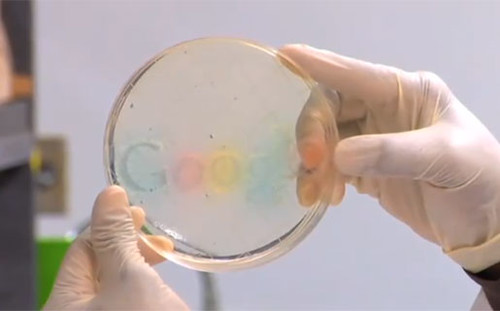
EVMS Creates Living Rendition of the Google Logo
Hypothesis: it is possible to create "living art" using live bacteria that have absorbed food colouring
This amusing video shows how cell biology professor Dr Edward Johnson and his PhD student, Clayton Wright, from the Eastern Virginia Medical School were able to grow a 'living' Google logo in their microbiology lab as part of the Demo Slam competition.
This video reminds me of my undergraduate years when I was working towards my degree in microbiology. One of the experiments I did was to culture phospholuminescent bacteria from the gills of fish captured in the Puget Sound. After I had a pure culture, I decided I wanted to have some fun by drawing a picture, entirely of bacteria, on a petri plate. After the bacteria multiplied, that picture glowed in the dark. Like the scientists in the video, my "bacterial artwork" worked beautifully on the first try.
How the "Living Google Logo" experiment was done: E. coli bacteria BL21 LysS is a laboratory strain that is harmless to humans but very useful for growing specific genes used in studies of cancer and AIDS. These bacteria are commonly used as microscopic factories to produce millions of copies of these genes which are then used in experiments.
To do this experiment, the scientists placed the bacteria into four small test tubes containing growth medium and added a small amount of common commercially available food colourings, one colour per tube for each of the four Google colors. After culturing the bacteria for four hours in the colored medium, investigator Clayton Wright used a sterile Q-tip to "plate" each population of the colored E. coli onto a Petri dish containing bacterial growth medium in agar. (Agar is a starch that hardens -- similar to gelatin -- to support growth of organisms like bacteria on a solid platform.) Clayton placed the bacteria on the agar surface in the Google logo style.
The scientists' primary concern was that the colouring would diffuse out from the bacterial colonies and not make a coherent Google logo. But after an overnight incubation, they found that did not happen. The coloring stayed with the bacteria quite well, and the Google logo grew out very nicely. They anticipated having to repeat this experiment many times to get it right, but it came out beautifully on the first try.
From: Punctuated Equilibrium
Wednesday, February 09, 2011
MD & VA in Top Three AP Scores
The top 10 states with the greatest proportion of their seniors from the class of 2010 having at least one successful AP experience were: Maryland (26.4 percent), New York (24.6 percent), Virginia (23.7 percent), Connecticut (23.2 percent), Massachusetts (23.1 percent), California (22.3 percent), Florida (22.3 percent), Vermont (21.8 percent), Colorado (21.4 percent) and Utah (19.2 percent). More: http://multivu.prnewswire.com/mnr/collegeboard/47746/
Monday, January 31, 2011
One question with Joe Meredith, president of the Virginia Tech Corporate Research Center
Do you have to be a rocket scientist to run the Virginia Tech Corporate Research Center?
Considering his educational background, you'd expect Joe Meredith would spend his days designing high-tech weapons systems, space shuttles and manned missions to Mars.
A bachelor's degree in aerospace engineering from Virginia Tech. A master's degree in aeronautics, astronautics and engineering science from Purdue University. A doctorate in industrial and systems engineering from Virginia Tech.
But for the past 18 years, Meredith's design work has dealt mostly with business plans and lease contracts as president of the Virginia Tech Corporate Research Center.
During his tenure, the center has grown to include 27 buildings with about 1 million square feet of space on a 120-acre campus. It is home to 140 private companies that employ more than 2,200 people. VT Knowledge Works, an incubator program at the center, is working with more than 50 startup companies. In September, the center was named the 2010 Outstanding Research/Science Park by the Association of University Research Parks.
So do you have to be a rocket scientist to run the Corporate Research Center?
"Gosh, I hope not, or I'll never be able to retire. I don't know that the aeronautics has had any benefit. I do think having a technical education has allowed me to develop stronger relationships in the park with companies that have managers who are technologists. It's easier to develop rapport if you think you have the same technical background.
"One of my educational experiences was at Defense Systems Management College [a U.S. government school for Department of Defense weapons systems program managers]. So I did have a number of business-related courses. Even though I don't hold a business degree, I got a little more business education than other engineering students.
"The CRC promotes two strategies: starting up and recruiting early stage companies as well as attracting large companies. At Newport News Shipbuilding [his previous employer; now Northrop Grumman], I was what is known as an 'intrapreneur' ... an entrepreneur working within a large company. When they had either new products or new divisions that they were interested in setting up, I had the opportunity to develop business plans and try to develop consensus to launch that initiative and raise money within the company to do that.
"Even as an intrapreneur I had to raise money within the company to launch a venture I was trying to launch. That gave me an appreciation of the challenges that an entrepreneur faces, and gave me insight into how large companies think. It gave me the experience to both encourage startups and attract major companies to the CRC.
"By having an engineering degree, you signal to the world that you're pretty much an analytical, logical thinker. As a result, people perceive me as predictable.
"Risk and your approach to risk are two different things. Engineers approach risk for risk minimization and predictable outcomes. I'm not going to do anything wild and crazy and out of the box. As an engineer, I hope people find me to be more approachable and more dependable."
By Michael Hemphill, special to The Roanoke TimesMonday, January 24, 2011
Richmond study recommends support for biotech park
An economic-development study prepared for the city of Richmond calls for enhancing the Virginia BioTechnology Research Park and redeveloping the former Armstrong High School on North 31st Street into a training and education center.
In addition, the study recommends a redevelopment initiative in which the city would identify and assemble up to 200 acres for a new technology or industrial park or corridor.
"The best opportunities for such a redevelopment initiative lie south of the James River, especially in the Manchester area and along Commerce Road," a team of consultants concluded in the Comprehensive Economic Development Strategy study.
The 134-page report, which has been approved by the federal Economic Development Administration and is a prerequisite for federal funding, cites the area's access and proximity to rail, Interstate 95, the Port of Richmond and land that could be made available for development.
While directed largely toward federal initiatives, the study emphasizes projects that support the development of work-force skills, as well as jobs in "knowledge-based industries, such as the life sciences and biotechnology sector."
To that end, the study suggests that the city join with state and local partners to seek federal grant funding to support the proposed Virginia Life Sciences Commercialization Center at the BioTechnology Research Park downtown.
As envisioned, the center would include wet and dry lab facilities, offices and space for light assembly. In addition, the city could seek federal assistance to start a revolving loan fund focused on small- and medium-size businesses in the life-sciences sector.
Further, the study calls for redeveloping the former Armstrong High School into a modern training center.
Mayor Dwight C. Jones' administration said the center would mesh with revitalization efforts for the Nine Mile Road and 25th Street corridor, as well as support institutions such as J. Sargeant Reynolds Community College, Bon Secours Richmond Health System and VCU Medical Center.
The high school was closed in 2004, when Armstrong merged with John F. Kennedy High School. The merged school, on Cool Lane, retained the Armstrong name.
The study was prepared by TIP Strategies of Austin, Texas, with help from the Hill-Christian Consulting Group of Richmond, through a yearlong process that included input from business and civic leaders.
The Hill-Christian Consulting Group is led by Sheila Hill-Christian, who worked as Richmond's chief administrative officer under then-Mayor L. Douglas Wilder, as well as a volunteer leader of Jones' transition. She also worked briefly as a paid consultant to the Jones administration and now represents the city on the GRTC Transit System's board of directors.
The Jones administration said it pushed to complete the $164,250 study after the city was on the verge of losing $105,000 in federal grant funds received from 2005 to 2007 to help cover the study's costs. The remaining costs were covered by the city.
In a rushed vote, the city council agreed last month to submit the study to the federal Economic Development Administration. At the time, council members said the Jones administration had not provided enough time to review the document.
Council members also have expressed frustration that the Jones administration has not had a dedicated, full-time director of economic development for the past 15 months. Peter H. Chapman, deputy chief administrative officer for economic and community development, has been serving as interim director while the position has been advertised.
In a statement, the Jones administration said Chapman's department has restored the city's credibility among economic-development stakeholders, including the Economic Development Administration.
"We are truly excited that another important avenue of funding will be opened up to Richmond as a result of completing this strategy," the Jones administration said.
By Will Jones
Richmond Times-Dispatch
Thursday, January 20, 2011
Fast-growing firm expands at biotech park
The fastest-growing company in the Virginia BioTechnology Research Park opened an expanded office and laboratory space Wednesday.
Since it was founded in 2009, Health Diagnostic Laboratory Inc. has grown from a staff of 11 people to about 180 employees. Its revenue reached about $70 million in 2010, said Tonya Mallory, the company's co-founder and chief executive officer.
The company still is hiring and expects to reach a total employment of about 210 this year.
"We're adding about a half a body a day," Mallory joked at a ribbon-cutting ceremony Wednesday for the company's expanded 42,000-square-foot office and lab space in the park's Biotech Eight building, which was shell space before HDL Inc.'s $4.2 million expansion.
"It's quite amazing what we have been able to accomplish," Mallory said. "We're glad to be in the city." She said all but a few of the people the company has hired are from Virginia.
The company's rapid growth is unusual for biotechnology, where firms often take years to develop products and grow beyond a handful of employees, or reach profitability.
HDL has tapped into growing demand in the health-care market, providing diagnostic services for physicians to help them with early detection of health conditions such as heart disease and diabetes.
The company's growth is a milestone in the park's 16-year history, said Robert T. Skunda, the park's chief executive officer.
The 34-acre park in downtown Richmond is home to 66 private sector firms, nonprofits, research institutes and government laboratories.
Biotechnology advocates hope that the General Assembly will pass legislation during the current session to spur more investment in biotechnology firms.
The Virginia Biotechnology Association backs legislation that would provide a refundable research and development tax credit for companies.
Two bills have been introduced that would provide a tax credit to Virginia companies amounting to 15 percent of the cost of qualified research and development expenses. As an added incentive to invest, the credit would increase to 20 percent if the research is conducted in partnership with a public college or university in Virginia.
"Certainly, I think it would be a help to many early-stage companies that we see here at the research park," Skunda said.
Companies would be able to apply for a refundable credit even if they are not profitable, said Mark Herzog, executive director of the Virginia Biotechnology Association.
Herzog said the credit would help companies obtain capital to reinvest in their businesses.
"In this economic environment, it is incredibly hard for many life sciences companies to obtain the capital they need to continue to make investments in equipment, clinical trials and people," Herzog said. He said 38 other states have a similar tax credit for research and development.
Mallory, the HDL chief executive, said a tax credit would help the firm expand its 10-person research and development staff.
By John Reid Blackwell
Richmond Times-Dispatch
Tuesday, January 18, 2011
Pixel Optics emPower featured on "Live! with Regis and Kelly
Roanoke-based Pixel Optics, a company presenter at Mid-Atlantic Bio in 2008, was featured this morning on "Live! with Regis and Kelly". In a segment about the latest in technology, the Pixel Optics emPower, the world’s first electronic focusing prescription eyewear, was shown by technology expert, Leo Laporte.